Outcome 3
Outcome 3. A moment when your career feels like it might collapse. Rumours spread, confidence disappears, and the system closes in. Sometimes survival requires finding another way forward.
Outcome 3
There are moments in surgical training when the noise stops and the verdict lands with a dull, irreversible thud. An email. A panel. A room with people who have already formed opinions. A single phrase that alters your trajectory.
Outcome 3.
For those outside the system, it sounds technical. Administrative. A box ticked on a form.
Inside the system, it feels existential.
My second child had recently been born. I was operating on fumes—sleep deprivation, surgical lists, portfolio evidence, the relentless treadmill of proving competence. Fatherhood clarifies focus, but it does not make the nights shorter. It does not quiet the rumour mill. It does not soften bias.
Childbirth makes you understand responsibility in a way no ARCP(Annual review of clinical performance) panel ever can.
But the ARCP does not care about that.
Outcome 3 means additional training time is required. It means something, somewhere, was judged insufficient. It means you are now vulnerable.
And vulnerability in surgery is dangerous.
Horns and Halos
Surgery prides itself on objectivity. On measurable outcomes. On X-rays and blood results and angles and alignment.
But careers are not built on X-rays.
They are built on perception.
The “halo effect” is well documented. If someone believes you are brilliant, they interpret your mistakes as minor aberrations. If someone believes you are problematic, they interpret your successes as flukes.
Gut feeling matters in surgery. It saves lives. But it also governs training.
And if your supervising consultant has already formed a negative view of you—consciously or unconsciously—every action is filtered through that lens.
A pause becomes hesitation.
Confidence becomes arrogance.
Questioning becomes incompetence.
In coffee rooms, conversations are rarely explicit.
No one says, “I don’t think he’s good enough.”
Instead it’s:
“He’s… interesting.”
“He’s keen, but…”
“Time will tell.”
And those murmurs travel faster than operative notes.
By the time you meet the next consultant on the rotation, they have heard things about you. Not necessarily facts. But impressions.
You walk into rooms already pre-labelled.
For a Black registrar in a system where representation is sparse, the margin for error feels thinner. You sense when people are waiting for confirmation of what they already suspect.
If your boss is prejudiced, overtly or subtly, it doesn’t matter how many times you stay late or volunteer for lists or teach the juniors. The narrative has already been drafted.
And once drafted, it is hard to revise.
Rock Bottom
Outcome 3 felt like public confirmation of private suspicion.
Was I not good enough?
Was this how it would end?
I had passed every exam since childhood. Navigated competitive interviews. Taken the long route into surgery. Done the research, the presentations, the late nights.
Yet here I was—officially “not progressing as expected.”
The irony was suffocating.
At home, I held a newborn. A fragile human whose entire existence depended on me. My wife was exhausted. Our household ran on broken sleep and logistical compromise.
At work, I felt like I was being evaluated not just on skill but on existence.
Sleep deprivation and scrutiny are not a good combination.
There were days I wondered whether the system had quietly decided my ceiling.
There were days I considered whether survival required silence.
But something shifted.
Responsibility
Becoming a father for the second time changed the internal dialogue.
Self-doubt becomes indulgent when someone else depends on you.
The stakes were no longer personal pride. They were generational.
There comes a moment in a man’s life when he stops asking whether something is fair and starts asking what he will do about it.
I could not control the rumour mill.
I could not control bias.
I could not control whether my name carried weight in rooms I had not yet entered.
But I could control one thing.
Visibility.
Lateral Thinking
The traditional advice in surgical training is simple:
Keep your head down.
Work hard.
Be patient.
Your time will come.
For some, it does.
For others, it does not.
Keeping my head down had not insulated me from Outcome 3. It had not protected me from whispers. It had not ensured that my strengths were recognised before my weaknesses were magnified.
So I decided to think laterally.
If people were forming opinions before meeting me, then I needed to shape that first impression.
I needed a vehicle.
I needed something that would travel into rooms before I did.
At that time, substantive consultant interviews felt four years away. In reality, they were eight. But I did not know that then.
I only knew I could not allow my professional identity to be defined solely by internal politics.
And so, from rock bottom, Orthom8 was born.
Building a Reputation
I had seen others create medical content online. Armando Hanusogun had built an audience. Nabil Ibrahim had carved a niche. I remembered the animated “There is a fracture, I must fix it” video that circulated widely.
The idea was simple.
Orthopaedic revision content could be clearer. Visual. Structured. Memorable.
Candidates were repeatedly tested on the same concepts. Kienböck’s disease. Carpal tunnel. Fracture classifications. You memorised textbook paragraphs when often what you needed was pattern recognition.
Why not animate it?
Why not make it accessible?
I was artistic. I enjoyed design. I had nothing to lose.
So I taught myself animation.
Late nights. YouTube tutorials. Trial and error. Poorly rendered first drafts. Awkward voiceovers.
But it was mine.
Each short video was a small declaration:
I am here.
I understand this material.
I can teach it.
Orthom8 was not initially about influence. It was survival.
It was a way of reclaiming narrative.
From Scarcity to Strategy
Something interesting happens when you build something from scratch.
Your energy shifts from defensiveness to creation.
Instead of worrying about what is being said in coffee rooms, you worry about script clarity. Instead of replaying criticisms in your head, you edit transitions.
Creation is empowering.
Gradually, people started to recognise the content.
Trainees messaged. Consultants mentioned it in passing. Colleagues forwarded links.
My reputation began to extend beyond the immediate rotation.
That was the key.
If your entire professional identity depends on the opinion of three consultants in one hospital, you are fragile.
If your identity spans a wider ecosystem, you are resilient.
Orthom8 did not change my ARCP outcome overnight.
But it changed my internal posture.
I was no longer solely reacting.
I was building.
Preparation Meets Opportunity
Years later, when substantive consultant interviews finally came, something unexpected happened.
In both interviews, someone on the panel had heard of Orthom8.
In both interviews, my name was not entirely new.
The vehicle I built at rock bottom had travelled further than I anticipated.
The eight-year gap between Outcome 3 and consultant interviews was not wasted time. It was compound interest.
But in 2016, I did not know that.
All I knew was that I could not allow myself to be defined by a panel’s decision.
Lessons from the Low Point
Looking back, Outcome 3 was not the end.
It was the pivot.
It taught me:
- Never rely solely on internal validation.
- Build assets that travel beyond one institution.
- Bias is real—but strategy can outpace it.
- Visibility is risky—but invisibility is fatal.
- Rock bottom clarifies ambition.
There is a particular strength that emerges when you realise you have nothing left to protect.
Once you accept that you are already scrutinised, already doubted, already whispered about, fear loses its edge.
You begin to act boldly.
Winning
When my second child was born, I felt overwhelmed.
Responsibility can feel like weight.
But weight builds muscle.
November 2016 was one of the lowest professional moments of my life.
It was also the moment I stopped playing defence.
Surgical training can be brutal. The system is imperfect. The rumour mill is relentless.
But it is not omnipotent.
You can outwork it.
You can outcreate it.
You can outlast it.
Outcome 3 did not define me.
It forced me to define myself.
And from that definition came Orthom8.
From Orthom8 came recognition.
From recognition came interviews.
And from interviews came the consultant life that once felt impossibly distant.
Rock bottom is rarely where the story ends.
Sometimes it is where the real work begins.
Forgotten
Months after CCT, I found myself unemployed, filling out forms and applying for locums while the system moved on without me. When the operating stops, a surgeon must ask a difficult question: who am I now?
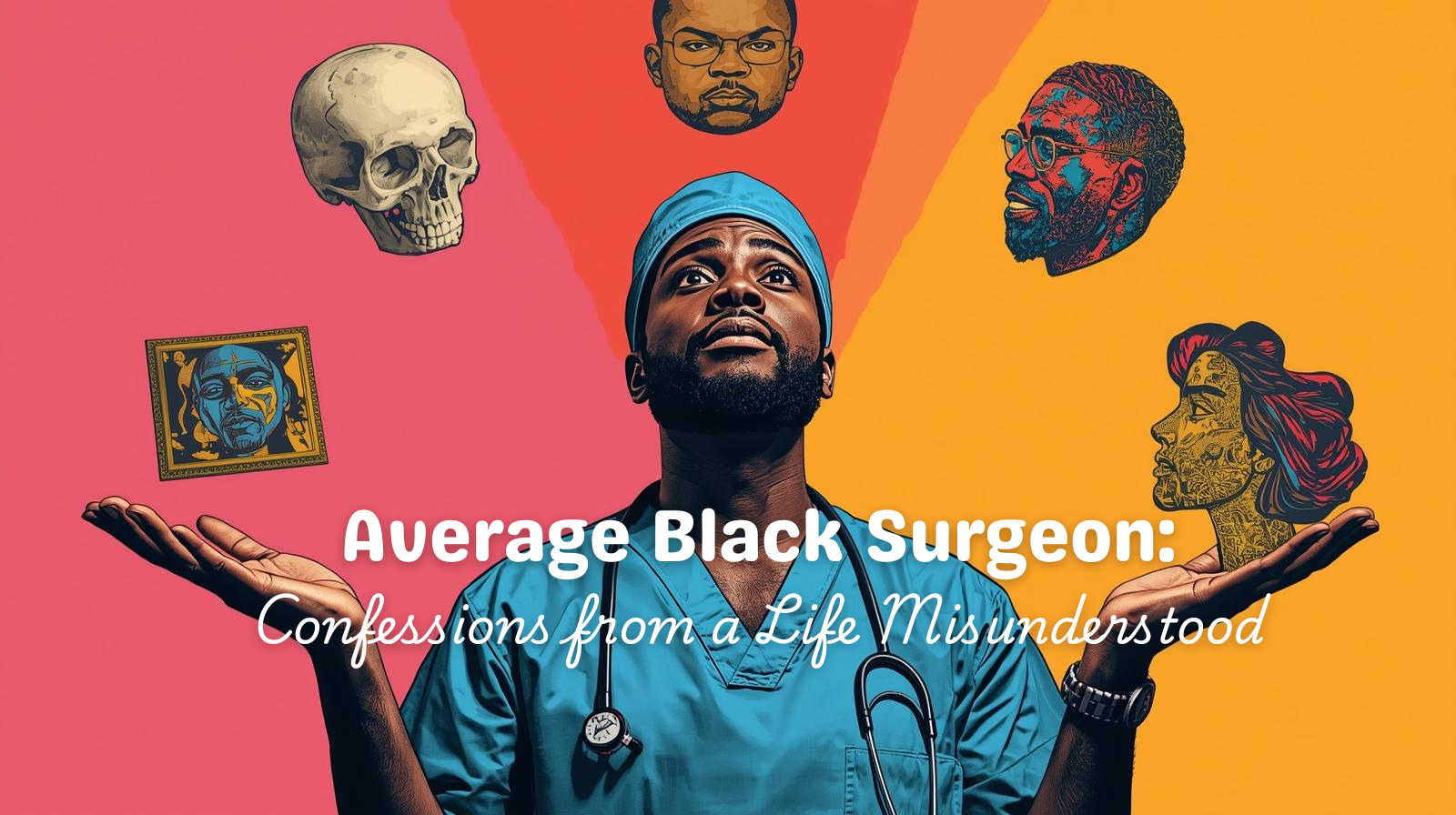
Average Black Surgeon: Confessions from a Life Misunderstood